Valorant lowest to highest rank challenge shows how fast a Radiant player climbs from Iron
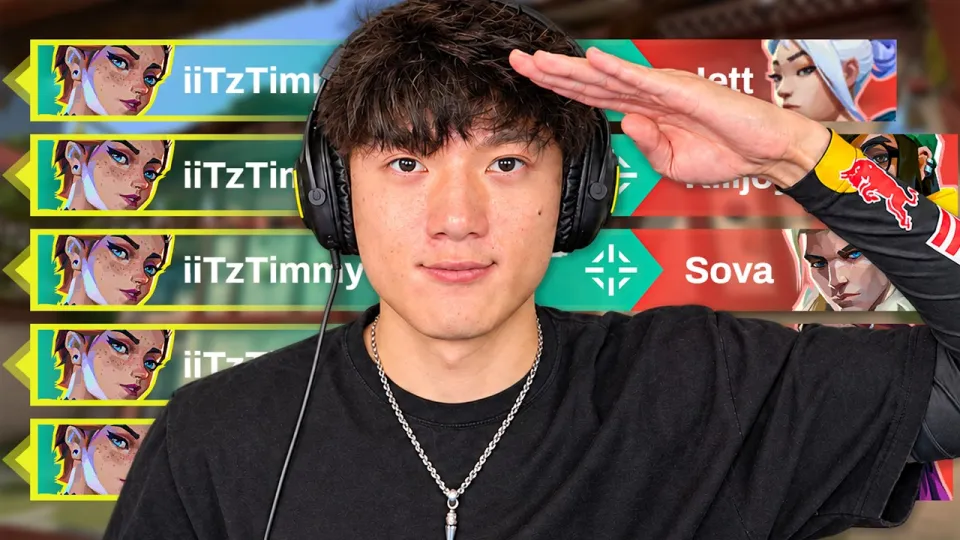
Video: I Might Be Getting TOO Good at Valorant… (Lowest To Highest Rank Challenge)
Need articles like this for your video? They help promote it on YouTube and Google — order them in the Telegram bot @sat_sit_bot. Articles with your video embedded are written and posted by the bot itself — on popular topical sites (no ads). Your first 50 articles are free.
Key takeaways
- The challenge format: start at the bottom of the Valorant ranked ladder and climb as far as possible, ideally to Radiant.
- iiTzTimmy Two published the run as a full low-rank-to-high-rank session, with the stream live at twitch.tv/iiTzTimmy.
- Low elo games are decided less by aim than by utility usage, comms and tilt control.
- A Cypher in the opening match drew heavy criticism for blaming teammates and mishearing calls.
- The second lobby reacted to a recognizable high-profile player far more than the first.
Valorant's lowest to highest rank challenge is a climb from Iron and Bronze up the ranked ladder toward Radiant, and it works because a top-tier player's fundamentals — crosshair placement, utility timing and economy discipline — are already far above low elo. In the iiTzTimmy Two video, the run doubles as a stress test of how much of ranked Valorant is decided by mechanics and how much by communication, mental and team structure. You can follow the live version of these climbs on iiTzTimmy's Twitch channel, where the full sessions air.
What the lowest to highest rank challenge actually tests
The challenge is not a pure aim benchmark; it measures how quickly a strong player can convert individual advantages into team wins across ranks that play by completely different rules. In Iron and Bronze, opponents hold odd angles, stack sites without logic and rarely trade kills, so standard high-elo defaults stop working. A Radiant-level player has to adapt downward before climbing upward: take more duels, play for picks instead of set executes, and stop expecting teammates to fill roles.
Three things separate the tiers in practice:
- Mechanics. Aim and movement carry a player out of Iron and Bronze quickly, because raw duels are common and opponents miss more.
- Utility and economy. From Silver through Diamond, winning depends on trading utility, saving correctly and not over-buying on half-buy rounds.
- Comms and mental. In Ascendant and above, teams punish silence and tilt, so information and composure become the deciding factor.
The video's opening match is a case study in the third point: a Cypher player becomes the focal point of frustration, calling out teammates while making questionable plays and mishearing a cage-related call. That is the exact behavior that stalls climbs at every rank, and it is more instructive than any highlight frag.
Why low elo lobbies break high-level habits
Low elo punishes assumptions, and that is why strong players sometimes drop early rounds in Iron and Bronze. A player used to set rotations expects a teammate to hold a flank; in a low lobby that flank is simply open. A player used to coordinated site takes expects smokes and flashes; instead the entry dies alone and the round collapses.
The fix is to simplify. Play self-sufficient agents, take early duels on your terms, and treat every utility piece as something you must use yourself rather than something a teammate will complete. That approach also explains the common viewer observation that low-rank games feel chaotic compared to Gold or Platinum — the difference is not speed, it is the absence of shared structure.
Reading the two lobbies in the iiTzTimmy Two run
The first and second matches in the video behave like two different games, and the contrast is the most useful part of the footage. The opening lobby is defined by friction: one player nitpicks every decision, invents calls that were never made, and blames the team after dying first into site. That is the classic recipe for a lost ranked session regardless of skill.
In the second match, the dynamic flips. Opponents recognize the player behind the Clove and respond with desperation — over-peeking, chasing kills, forcing duels they should avoid. Fans in the comments noted how much more famous the streamer was than anyone else in that lobby, and the lobby's behavior confirms it. There is also a small detail viewers flagged around a kill on Clove where the ultimate did not appear to activate as expected, which is the kind of bug report that surfaces in every long session.
The mechanics that make the climb look easy
A fast climb looks effortless because the fundamentals are invisible until you compare them side by side. Three habits do most of the work:
- Crosshair placement. Keeping the crosshair at head height on the angle you are about to clear removes the need for reactive flicks.
- Peek discipline. Wide swinging into multiple defenders loses rounds; short peeks and shoulder peeks gather information safely.
- Flick consistency. Highlights like a long-range flick on a barely visible target are the visible output of thousands of repetitions, not luck.
Add hardware comfort — high frame rates and stable sensitivity — and the mechanical gap between a Radiant player and a Silver lobby becomes obvious within a few rounds. Viewers regularly ask about sensitivity and DPI settings for exactly this reason; the honest answer is that settings matter far less than consistent practice on the same values.
Common viewer questions about ranked climbing
Ranked climbing questions repeat across every region, and the video's comment section reflects the usual set. The recurring themes are worth addressing directly:
- "Why does my aim not carry me out of Gold?" Because Gold lobbies already punish solo aggression; trading and utility usage matter more than raw duels.
- "Is the challenge rigged by smurfing?" No — the format is explicitly a climb from the bottom, and the point is to show the gap between tiers, not to hide it.
- "Do comms really matter in low elo?" Less for winning individual duels, more for preventing repeated mistakes; a single clear call per round beats constant chatter.
- "How long does a climb take?" It depends on win rate, not games played; a strong player moves several divisions in a session, while a 50 percent win rate stalls.
The most repeated lesson from the footage is mental: the player who tilts and audits teammates loses more rounds than the player who simply resets and takes the next duel.
Useful links
All official channels from the video, exactly as listed:
- iiTzTimmy on Twitch — live streams of the ranked climbs
- iiTzTimmy on Twitter
- iiTzTimmy on Instagram
- iiTzTimmy on TikTok
- iiTzTimmy Discord
Final thoughts on the climb
The lowest to highest rank challenge is entertaining because it exposes the parts of Valorant that ranks cannot measure: patience, communication and the ability to adapt to a lobby that does not play the way you expect. The iiTzTimmy Two run makes that visible through two very different matches, one defined by tilt and one by opponents chasing a famous name. Anyone stuck in a rank should take the same lesson — fix the mental, simplify the utility, and let mechanics do their job. For more full sessions, watch the climb live at https://www.twitch.tv/iiTzTimmy.
Questions & answers
What is the Valorant lowest to highest rank challenge?
It is a climb format where a player starts at the bottom of the ranked ladder, usually Iron or Bronze, and tries to reach the highest possible rank, ideally Radiant. The point is to show how fundamentals translate across tiers rather than to prove a single mechanical skill. Because the account starts low, every division reveals a different style of lobby.
How long does it take to go from Iron to Radiant in Valorant?
There is no fixed number, because progress depends on win rate rather than games played. A player winning most matches can move several divisions in a single long session, while a 50 percent win rate effectively stalls the climb. Climbing also slows in Ascendant and above, where opponents punish mistakes and silence far more consistently.
Why do high-rank players sometimes struggle in low elo lobbies?
Low elo does not follow high-elo defaults: flanks stay open, site executes fall apart and teammates rarely trade. A strong player has to simplify, take personal duels and use utility independently instead of expecting coordination. Once the approach adapts, mechanics usually decide the outcome quickly.
Does mental really decide ranked games in Valorant?
Yes, especially in close lobbies where one player starts blaming teammates and mishearing calls. That behavior drains the team's information and focus, and it costs rounds that were still winnable. Resetting after a bad round and giving short, clear calls is a bigger upgrade than most aim routines.
Source: I Might Be Getting TOO Good at Valorant… (Lowest To Highest Rank Challenge) · Markdown version